I will always love you

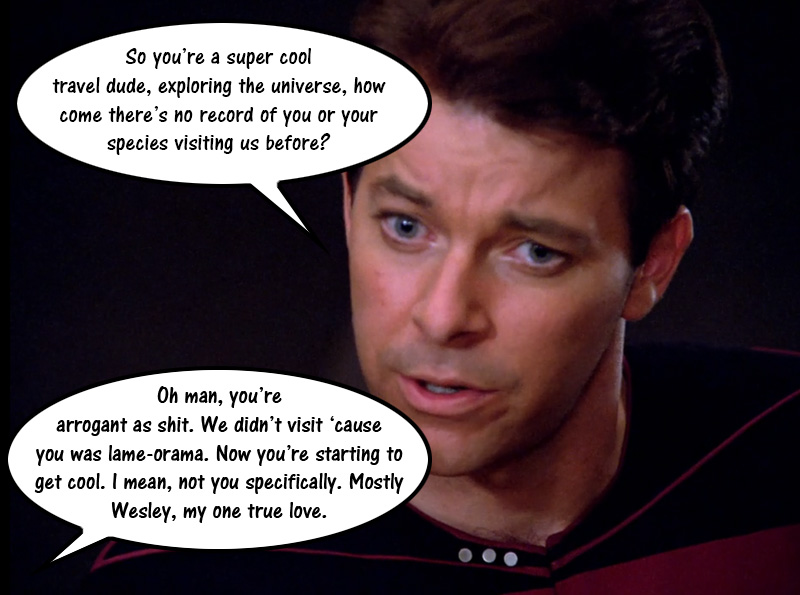
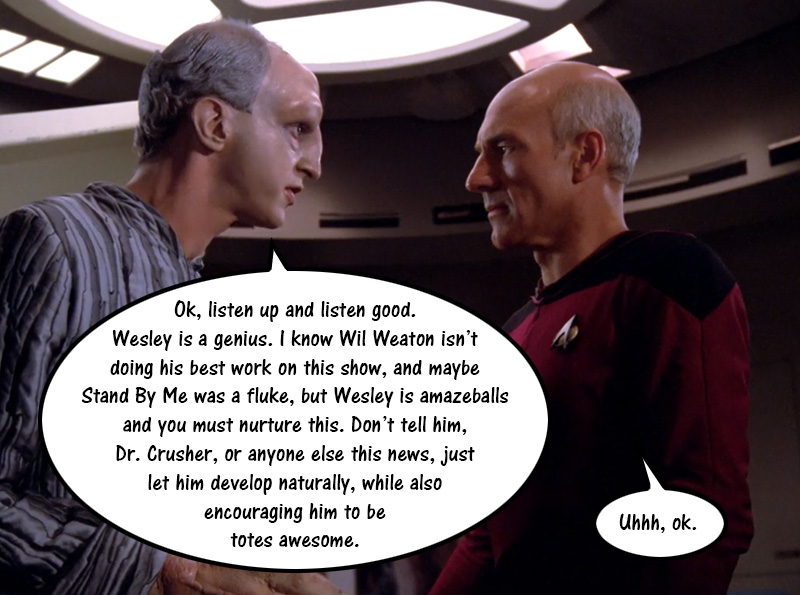
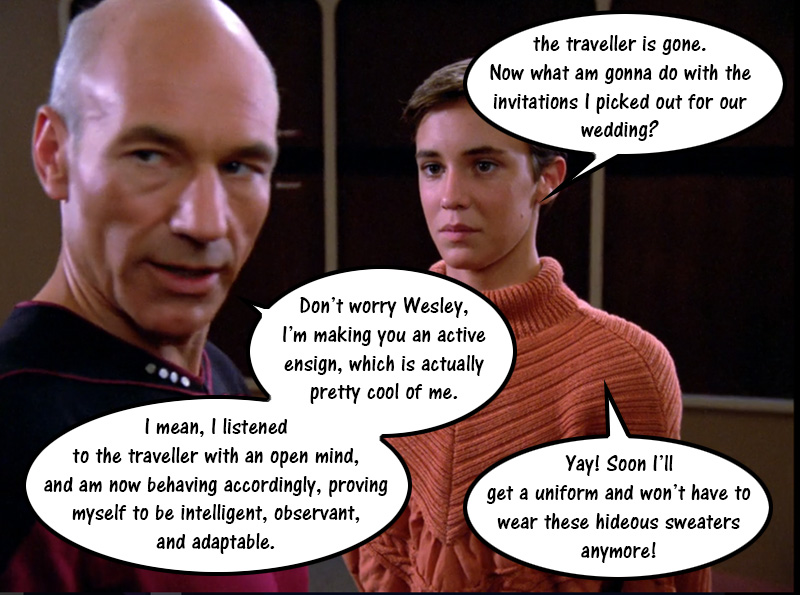
On September 28, 1987, something monumental happened. Something that would change the world, and would begin one of the most profound love affairs in my entire life. Star Trek: The Next Generation aired its premiere episode.

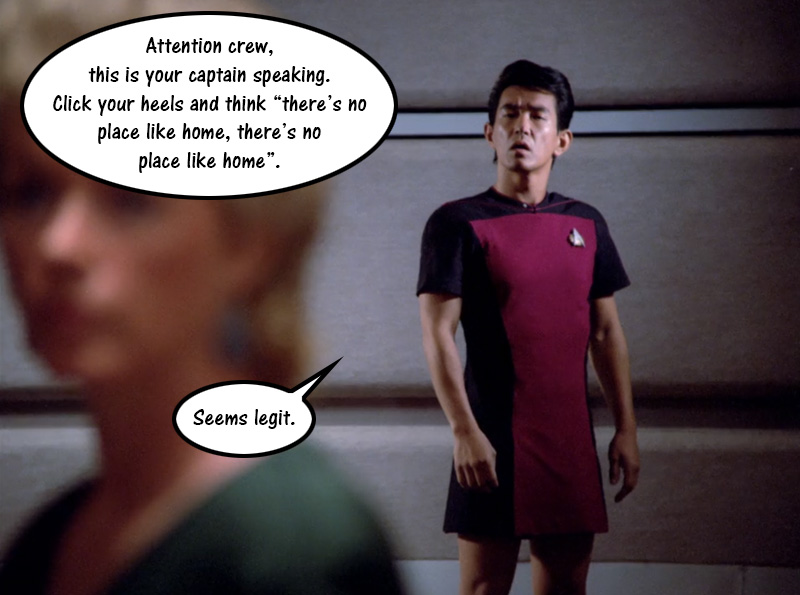
I was only eleven years old, but I was instantly hooked. TNG aired for seven seasons which means I was eighteen when it ended but by then Deep Space Nine had begun and soon, Voyager would come onto the scene. These three shows carried me into my twenty-fifth year, so Star Trek was a part of my life during my pre-teen years, my entire adolescence, and the formative years of my young adulthood. It is not hyperbole to say this franchise had a huge effect on me and helped to shape me into the woman I am today. I would even say these shows were partially responsible for raising me. That’s a scary thought when you rewatch the early seasons of TNG today, and realize how racist and sexist they were (I’m looking at you,  Code of Honor), but for the time, the show was revolutionary and the ’80s version of woke.

I’ve already written about how TNG came into my life at the exact right time; I was lonely and looking for something to believe in. Even though I didn’t have many friends in real life, the crew of the Enterprise D became my new friends – my surrogate family. They were a group of people who cared about each other, and all supported one another. They were the dream team and I wanted nothing more than to be part of that team. From the first moment I was instantly enamored with Deanna Troi because she was empathic – the premiere episode even implied that she was telepathic – and at the time I was so insecure and fearful of people that I wanted nothing more than to be able to read their minds, just so I could get an idea of how I was supposed to behave. In time I developed a crush on Data and I realize now that this is because he represented something safe. As someone incapable of emotions, he’d also be incapable of hating me, as I hated myself.

For young me, TNG was a beacon of hope, something for me to rely on as my life got increasingly difficult to deal with. As I fell into a depression during my adolescence, TNG was often the only thing getting me through the week, and cliffhangers like The Best of Both Worlds got me through entire summers. Looking for more of the same, I attempted to watch the original Star Trek series, hoping it would hold some of that magic I longed for. Unfortunately, it didn’t, and I was sadly disappointed. Just as the spin-offs don’t always hold up when viewed through a modern lens, teenaged me from the ‘90s couldn’t handle the overt sexism of the ‘60s series. (I’ve rewatched TOS as an adult though, and found it quite fortifying).

Still, I remained profoundly protective of the franchise, and deeply in love. Even as, throughout all the shows’ runs, I was often annoyed, (mostly with the lack of gender parity and meaningful stories for its rare female characters), I was also consistently moved, and watching the shows mostly remained a joyful experience.

As time has gone on, I’ve come to accept other shortcomings of the franchise, like its spotty understanding of science, and inconsistent ideas about future technologies. Writers from the 20th century can’t be blamed for guessing wrong about the future, and how our species would evolve, but watching the show now isn’t so much nostalgic as it is hilarious. And that’s fine. It’s still fun to watch, even if every episode needs to be taken with a grain of salt, and a gigantic helping of suspension of disbelief. And when watched within the context of the time it was made, the show can still hold valuable lessons, and serve as a teaching tool. Star Trek, as with all good science fiction, has always been its best when the storytelling was an allegory and not simply shoot-em-up space battles.

So I can’t blame fans for wanting to revive the franchise but I would argue that the modern reboot absolutely did NOT recapture that old Star Trek magic. They’re passable movies in their own right, but they are not Star Trek movies. They actually hold more in common with Star Wars, in that they are more action-oriented than allegorical. Again, that’s fine for people who are into that sort of thing, but for me, it’s not enough. What I’ve realized though, is that it’ll never be enough, that the old Trek magic simply cannot be recaptured because modern audiences are now too smart.

Ok, maybe not everyone is too smart, but generally speaking, as a culture, or at least for those of us who follow advancements in science, we’ve come to see that the tech as shown in Star Trek makes no sense. Some of it is way too advanced and some is not advanced enough. Today, in 2017, we have smartphones that seem more advanced than the PADDs the crew of the Enterprise walked around with. Why are crew members constantly seen walking around to deliver information when even today a simple email will do? And you’re telling me that in the 24th-century people still only live into their hundreds? And genetic engineering is banned? There’s no cure for blindness? And nanotechnology is seen as novel? And women are still expected to take their husband’s names?!?!?!?!?!?!?!?!

Again, a lot of this comes down to the time in which the series was made, but that’s exactly why it can’t still be made today. We know better. Handcuffing writers with the limitations of the established Trek tech seems like a particularly cruel form of torture. I would actually argue that writing any sci-fi today is similarly difficult, and current space-faring shows like Dark Matter and Killjoys are also laughably unrealistic, but at least they aren’t also hampered by decades of highly limiting (and sometimes internally inconsistent) cannon.

The only wise and merciful, thing to do is to let Star Trek die. Let it rest in dignity as a much-loved franchise that was good for its time. Leave it the hell alone! But no, much as there was coffee in that nebula, there is money to be made, so of course, they’re taking another kick at the can.

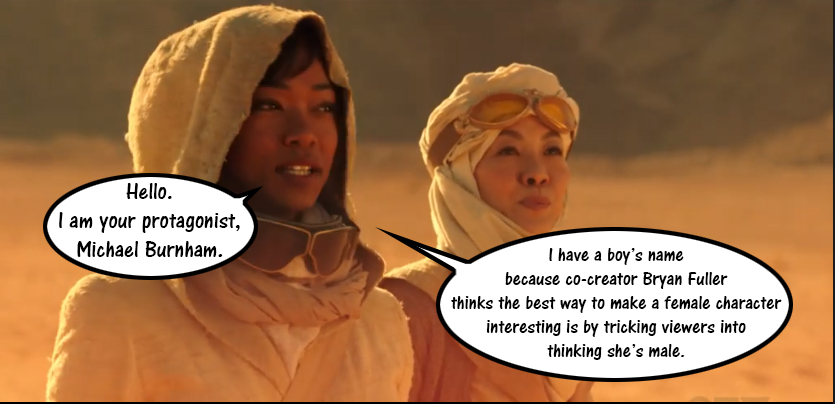
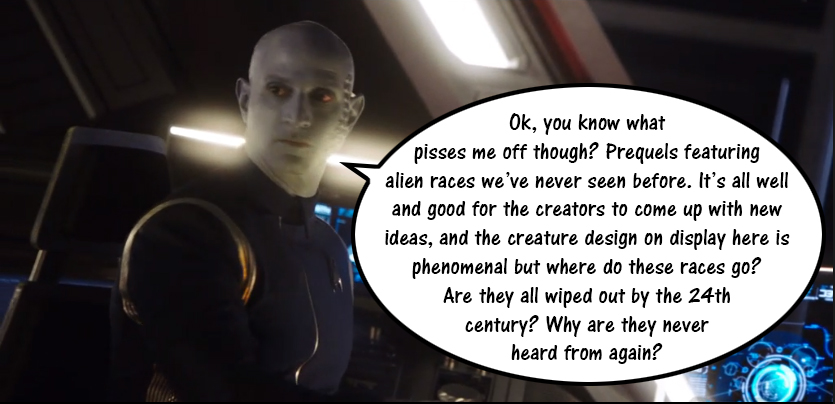
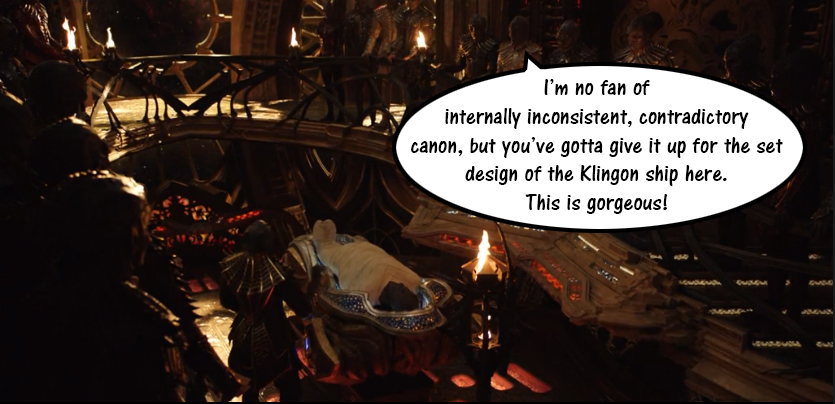
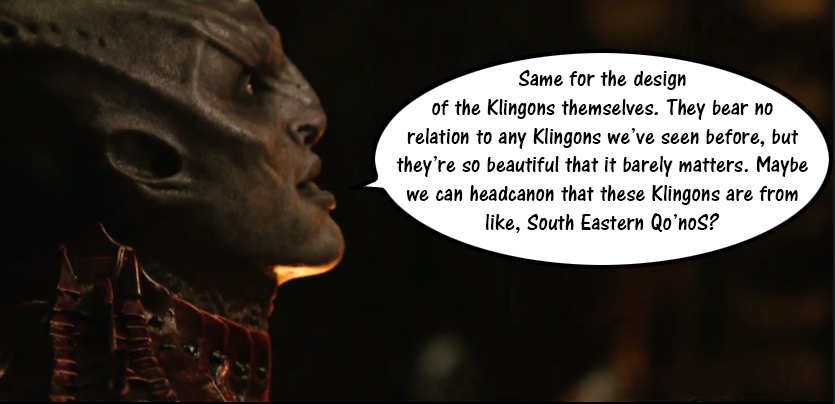
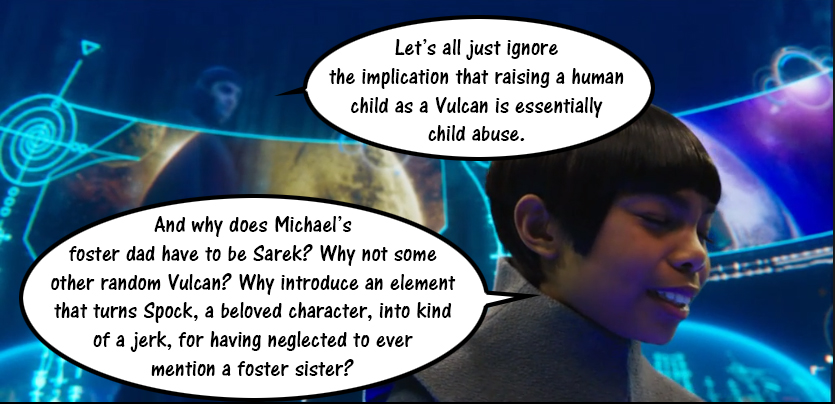
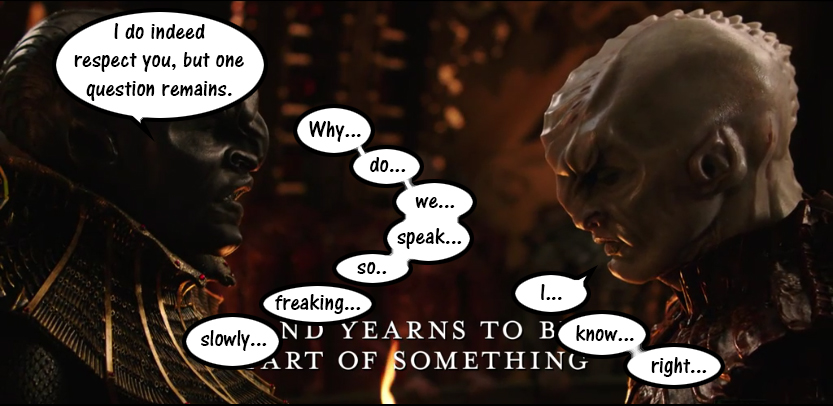
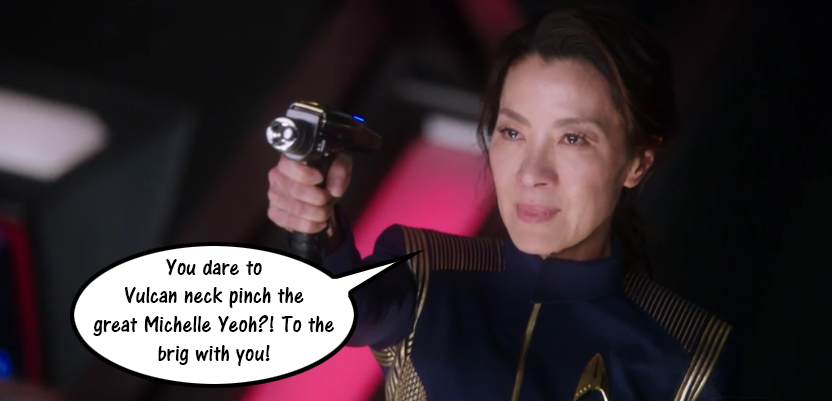
Which brings us to my ultimate purpose in writing this blog post. I am deeply apprehensive about the new Trek series set to premiere this year, Star Trek: Discovery. We all know it’ll be a shit show because how can it not be? The producers have already admitted that they are redesigning the Klingons yet again, because hey, if the Klingons need anything it’s even more confusion regarding their turtle heads or lack thereof.

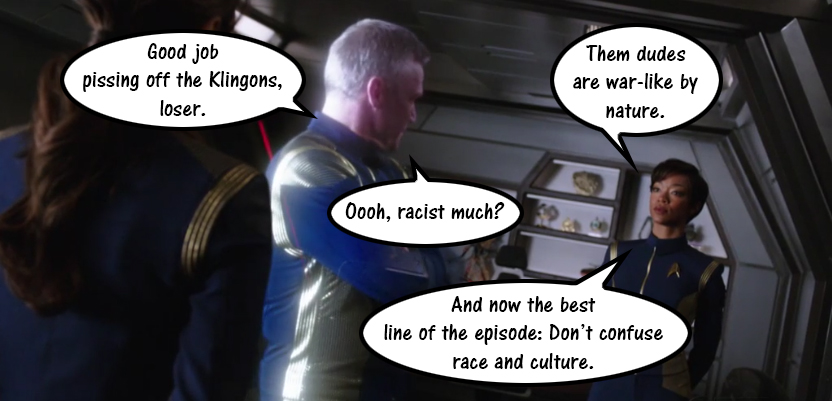
I am hopeful about the black woman lead but disappointed by the continued lack of gender and racial parity. A bit of intertronning reveals that the show is still 69% white and only 30% female. *sigh*

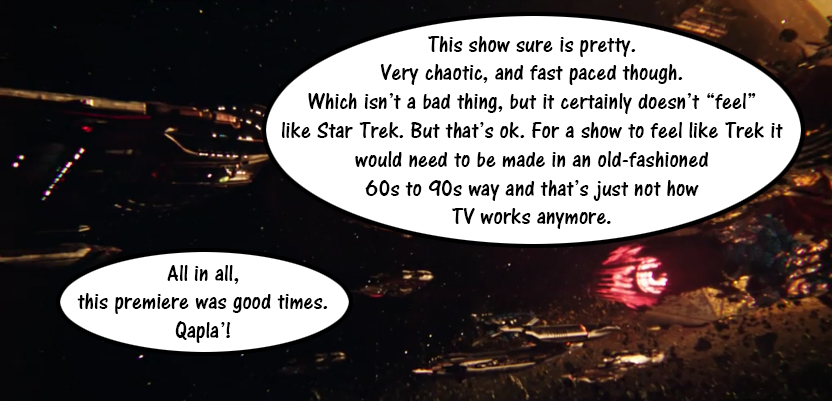
I’m not reading up too much about Discovery in order to avoid spoilers, so I can’t say much about it yet except to say that yes, I will of course be watching it. I’ve even started rewatching older Trek in an effort to get back into that Trek mood, and so far it’s working. I’m very much worried about what Discovery will do to a franchise that has already taken way too many hits, but two things are certain: I will absolutely love it and absolutely hate it.

star-trek-discovery-logo

White

White’s not my jam. I’m about two shades paler than transparent so wearing white makes me look like a ghost. In fact, I’ve quite effectively worn lacy white dresses and a white wig a couple times for Halloween and successfully passed as a Victorian ghost, without needing to apply whitening makeup. For this reason I have very little white in my wardrobe. I don’t mind it as an accent in an outfit but I’ll never wear something that is dominantly white. That having been said, a couple years ago I had to go to a white party for work, so I went to a thrift store and got a white cardigan to wear over the one white tank top I own, which I paired with a skirt that is the closest to white that I’ve got, to make the outfit you see below (but IRL I refrained from collapsing in the snow). To my surprise I didn’t look entirely horrible. But white will never be my go-to, perhaps in part because of what it represents.

white-board1

White symbolizes purity, innocence, and cleanliness. It is the opposite of black: in light it is all colours, in pigment it is none. White is a blank slate, an empty canvas. While black is the colour of death and mourning in western culture, in other cultures white fills this role, due to the idea of death being the beginning of a new life, of renewal. In western culture white is worn by brides because of its association to sexual purity, which is a rather gross and outdated concept. This regressive and oppressive attitude towards women is actually one of the reasons I resist the idea of marriage, though also one of the only reasons I ever would tie the knot: simply so I could wear something garishly colourful as a bride.

white-board2

The other situation where a white wardrobe is mandatory is in a clinical setting, where researchers and medical professionals wear white lab coats. This makes sense, as white evokes the feeling of hygiene and transparency, and it will highlight stains, forcing clinicians to stay clean. There was once an episode of Star Trek: The Next Generation where doctors wore red for surgery and I remember thinking how silly this was. Today surgeons wear green or blue because this colour is the opposite of red, i.e. the colour of blood. Of course, in the TNG future, no blood would be spilled during surgery, but red still seems like the least intuitive colour for surgeons to wear, and others agree with me. In any case my initial point was that red is in no way a hygienic colour, whereas white is. White is THE colour of hygiene.

white-board3

So rock on, white. I’ll never want to wear you, but I will continue to insist on doctors wearing crisp, freshly laundered white coats. Doctors are assholes, (and one day I’ll write an epic rant about my life-long distrust of medical professionals) but at least the semblance of a uniform keeps them from entirely forgetting that they are meant to serve the people, and not the other way around.